The Brief: B and R came to me knowing exactly what they didn’t want, which is a fantastic starting point in my mind. (Easiest way to know what we need to avoid and then why!) They were looking for nothing predictable, and nothing that felt like every other wedding they’d been to. No black and white checkered dance floor, no schedule that ran the same order as every reception they’d ever sat through. What they couldn’t tell me was where any of it should happen, and that’s where we started.
The Context: They’re based in Colorado and they’d already looked through the Denver wedding planner options. None were quite the right fit, and I think what they were actually reacting to was a sense that the wedding they’d get would be a version of something that already existed rather than something built for them. They wanted a location with interesting architecture, and overall weren’t keen to dump too much of the budget into a tent and rely on the unpredictable Colorado weather.
There was also a reference point sitting behind all of this: R’s sister had gotten married at a resort in Colorado, and by his read she was stressed the entire lead-up and it was hard to see where the money had gone. That experience shaped what they wanted more than imagery alone: they knew they wanted to feel confident in their decisions, not to be figuring things out on their own at eleven at night, and not to arrive at their own wedding already exhausted.
When I asked them to describe the wedding as a feeling instead of a schedule, R said he wanted it to feel timeless, like it stopped time for a moment and transported everyone somewhere. B said she wanted their personalities in every part of it, and that each event needed an actual purpose rather than existing because it’s what people do. They were imagining five events across four days: casual welcome drinks, a welcome party for family, a sit-down pre-wedding dinner with speeches, the wedding with a proper after-party, and a brunch the next morning.
Their parents had given them a number, and it was firm. When I asked how they ranked the following three elements: experience, guest count, and budget, they both said, without hesitating, that experience is number one, budget second, and guest count third. This ranking is the best first step in our kick-off call as it tells me how a destination needs to provide and how cost factors in.
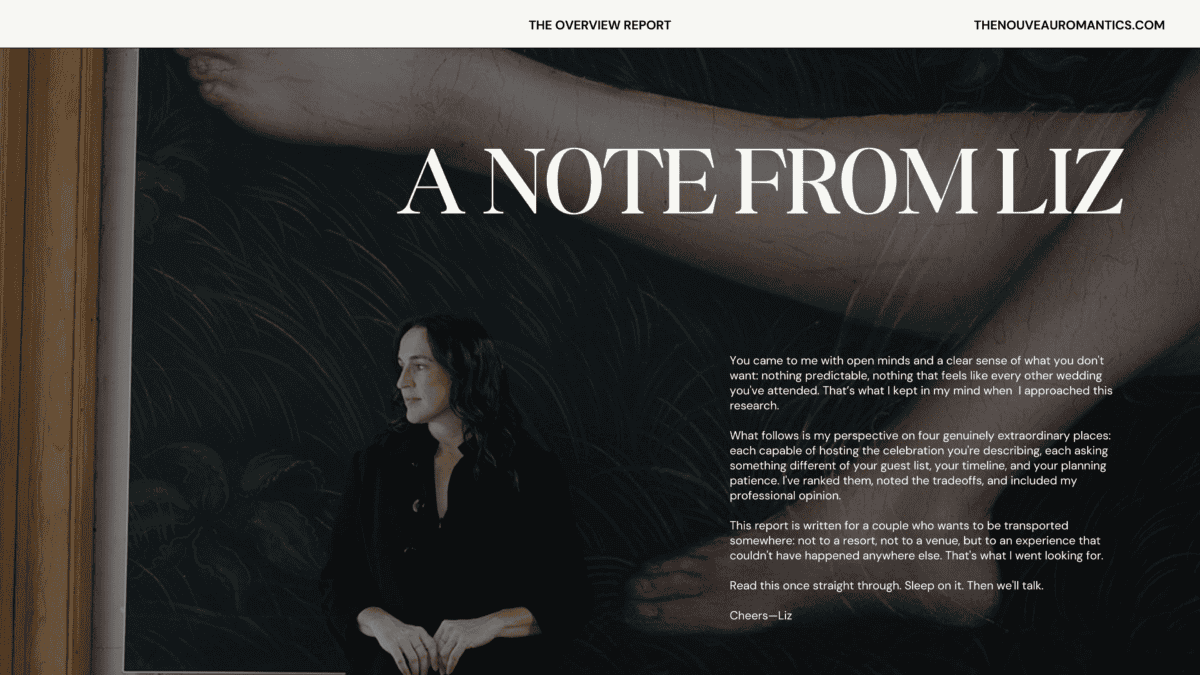
Why Four Destinations Instead of Three
The Destination Edit’s “The Overview” covers three destinations, and the reasoning behind the limit is that comparing more than three well can be overwhelming and the report stops being useful once it turns into a catalogue (and analysis paralysis sets in). B and R added a fourth as an add-on, and in their case it was the right call because the four places were different enough from each other to make the comparison helpful rather than repetitive.
We looked at Istanbul, Lisbon and Sintra, Cartagena, Colombia, and Antigua, Guatemala.

Berlin, Germany (a gem!) was on my original list and got cut before the research started, which was a decision that we made early on. They’re moving there after their wedding, and they knew that if they got married in a city they were about to live in, they’d spend the entire weekend playing tour guide instead of getting married. These are the kinds of questions that guide the process and your own wedding experience that can get lost in spreadsheets and inspo pics.
What the Research Actually Covered
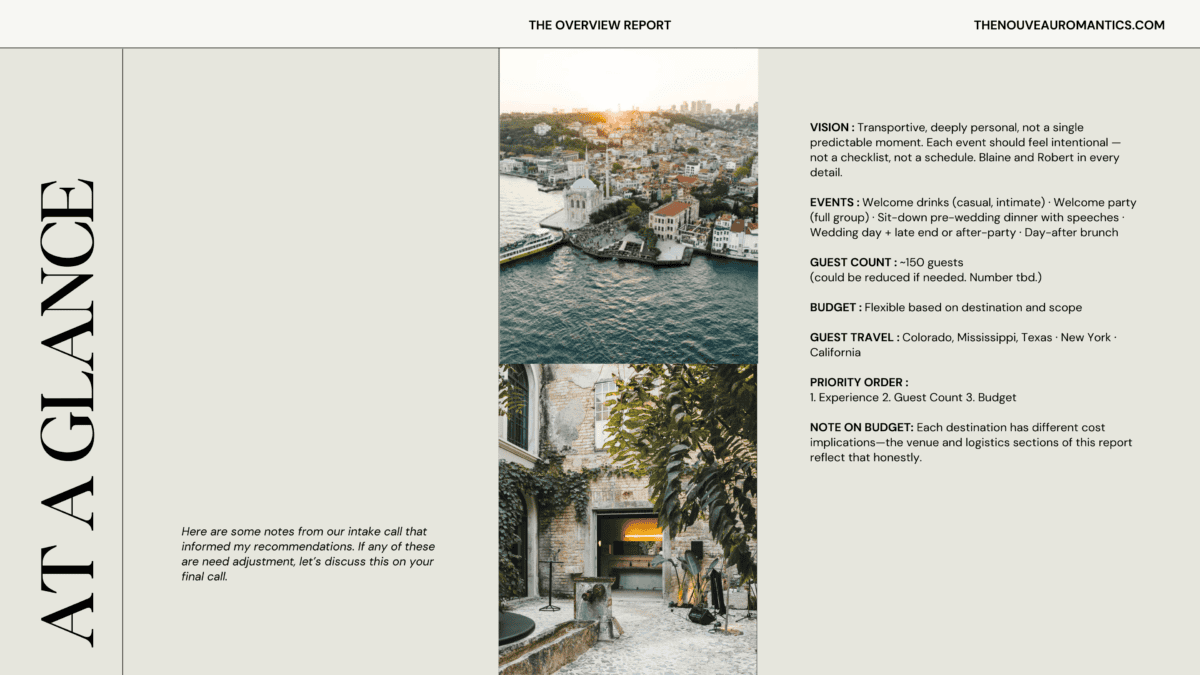
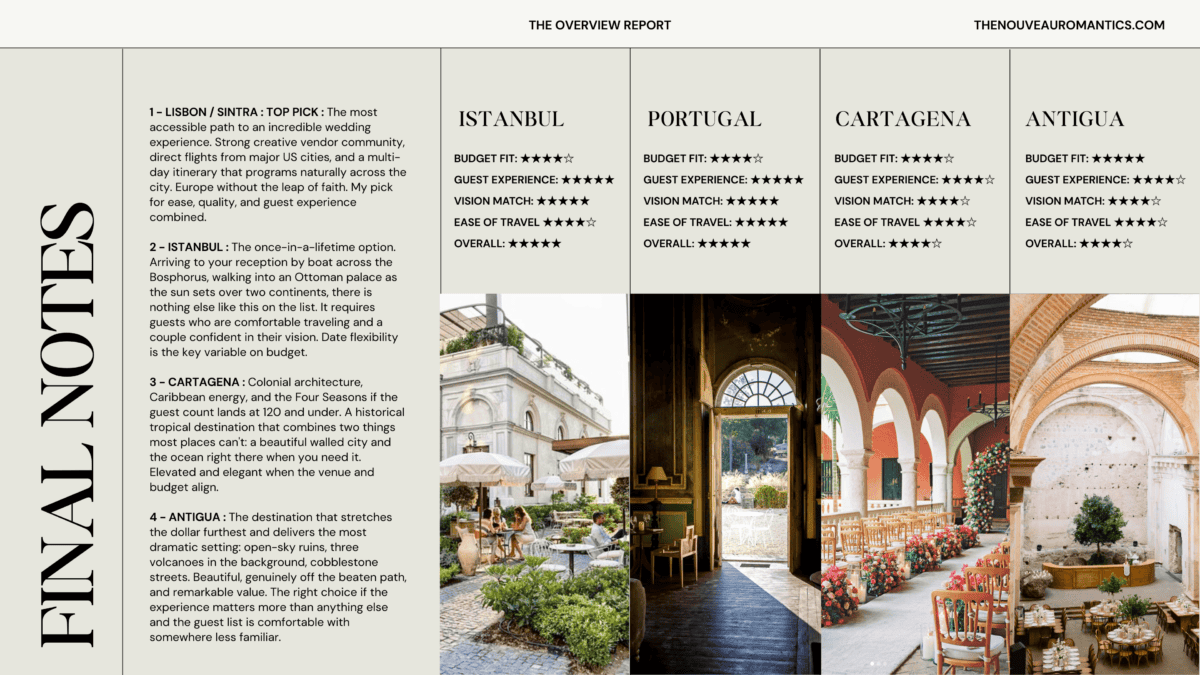
For each of the four destinations I put together a venue landscape mapped to their specific events, hotel recommendations across a few price points, flight routing and travel considerations from every city their guests were coming from, visa requirements, seasonality, what impacts the budget in each locations, and my professional opinion with the reasoning behind it. Every destination got scored across budget fit, guest experience, vision match, and ease of travel, and then ranked against each other at the end.
That fourth scoring category is worth mentioning, because it changes depending on the couple. For a South Asian wedding I’m scoring South Asian vendor infrastructure. For B and R, with guests coming from Colorado, Mississippi, Texas, New York, and California, and a good number of them not especially seasoned international travelers, ease of travel was the variable that guided the final decision.

A few things that came out of it:
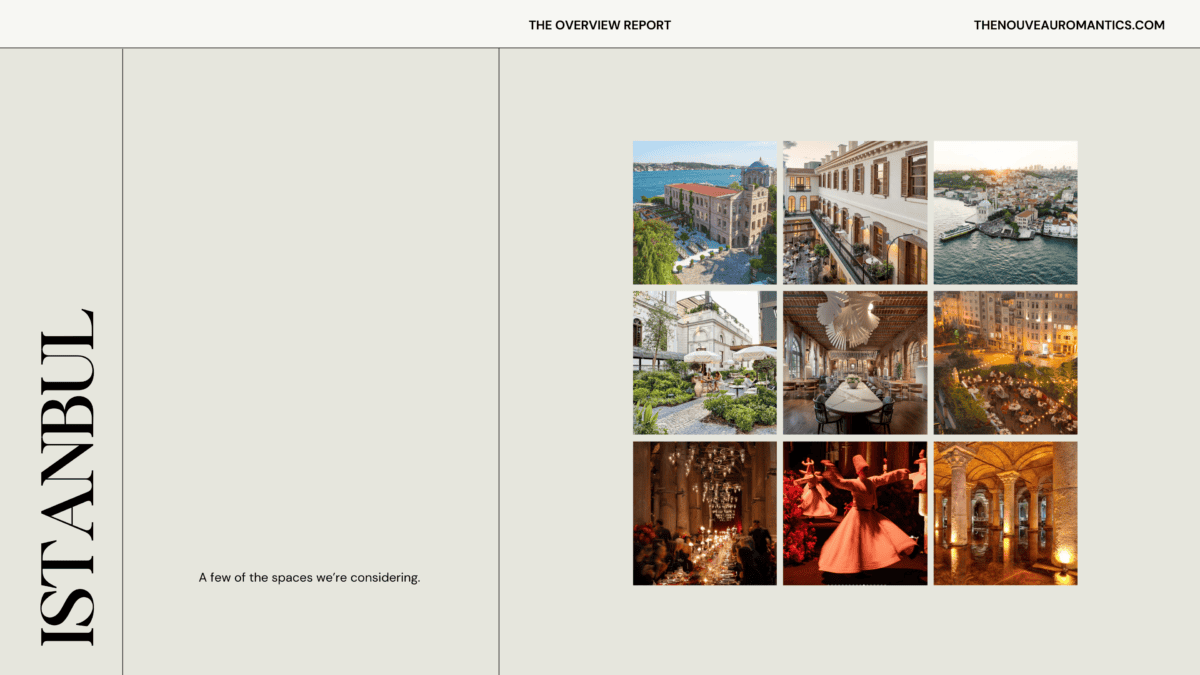
I’m a huge fan of Istanbul, and it has a massive impact factor. Arriving at your reception by boat on the Bosphorus into a nineteenth-century Ottoman palace as the sun sets over two continents … is not something you really find anywhere. Combined with a welcome party option in a fourth-century Byzantine underground cistern? Show me where you can do this elsewhere and I’ll buy you a drink. The purchasing power in Turkey is also strong right now. The flip side, however, is that requires a guest list that are comfortable travelers and a couple confident enough in the vision to hold the line when someone’s parent Googles the country and gets nervous. (IYKYK.)
Antigua, Guatelmala was the best value on the list by a wide margin, and visually the most dramatic: roofless colonial convents open to the sky with volcanoes and lush jungles behind them. It’s also the most logistically complex of the four, as the venue options are essentially historic ruins and hotels, the ruins have early end times, and depending on the level of production you’re looking for you may have to import it from neighboring countries.

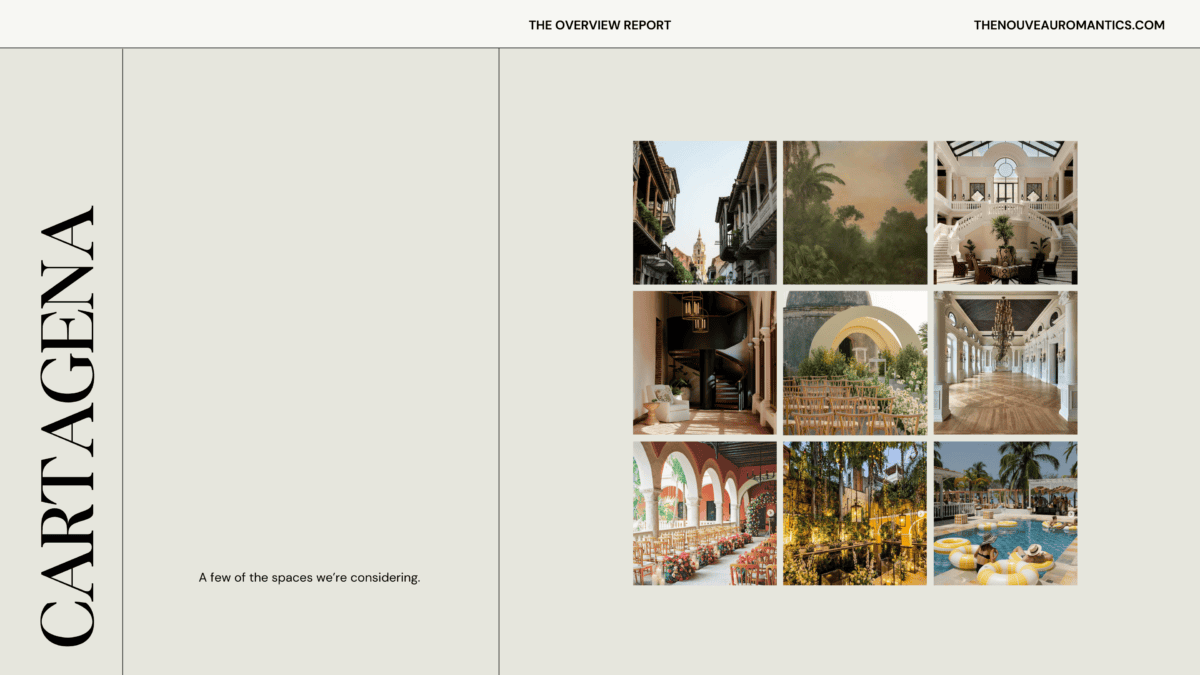
Cartagena, Colombia has a combination I love, which is a walled colonial city with the Caribbean sitting right there for the day after giving you a fantastic range of activities across multiple days. It works beautifully for smaller guest counts, which is helpful to know early as several of the best venues max out at 120 guests or less. It’s also … tropical … so humidity and heat are a thing and your guests need to be game for that (or at least prepared, style wise).
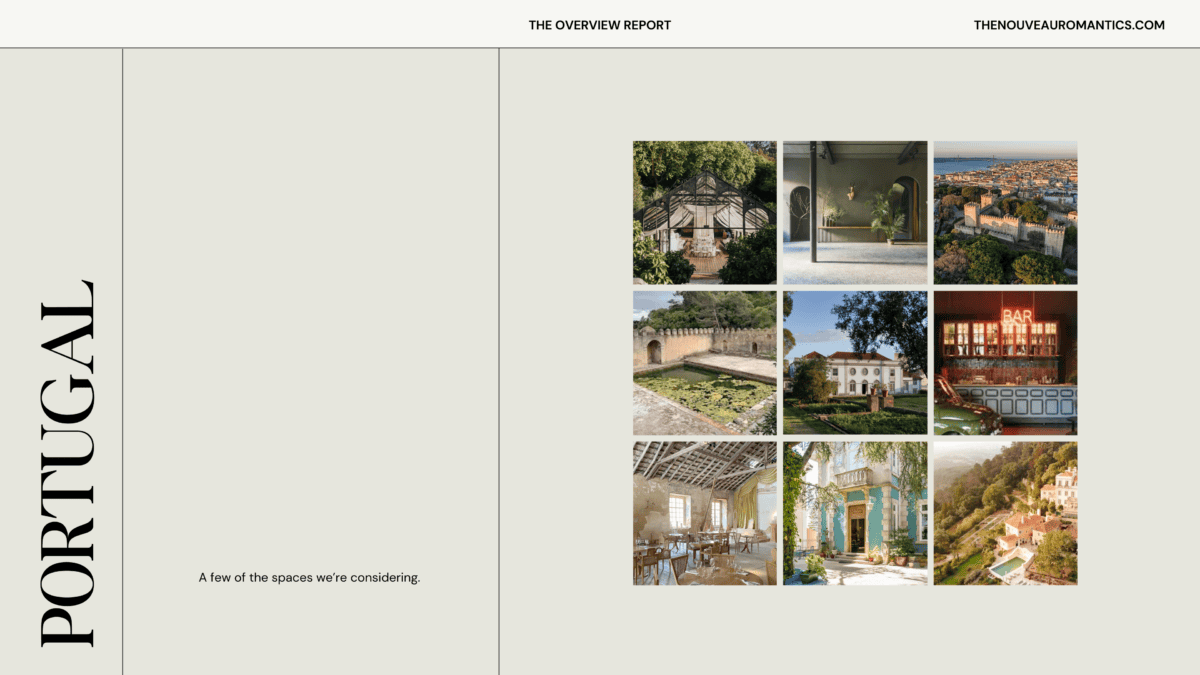
Lisbon and Sintra were my top pick, and the reasoning came down to the right mix for this guest group and their needs, and overall experience. The winning combo was: unexpected historic venues, a creative vendor community that’s strong in the ways B and R care about, easy direct flights from a number of their guests’ cities, a city that’s easy to navigate for people who haven’t done much international travel, and a multi-day itinerary that programs naturally without splitting logistics across two places. Europe without needing a massive leap out of anyone’s comfort zone, which takes any low-level fear out of the equation and gets everyone excited.
What They Chose and Why
They chose Lisbon too, though it wasn’t a forgone conclusion. Istanbul was a strong contender as they loved the venues, but ultimately guest list and guest experience took the lead.
A good portion of their guests don’t travel internationally extensively, and once that was noted, alongside flight routing from Denver, Dallas and Mississippi, the decision got simpler and easier. Lisbon gave them the exploratory, nothing-like-your-cousin’s-wedding experience they wanted without causing a lot of unnecessary travel stress for guests less traveled.
By picking a location a bit further afield, the guest count naturally reduced itself. They started at roughly 150, and they’re now planning for 110 to 120, which is a tradeoff I flag for every couple considering a transatlantic wedding. The difference here is that they chose it on purpose and a smaller number is always friends to your budget.
We’ve now moved forward as full planning clients and we’re deep in venue scouting and vendor outreach for a Lisbon wedding next May.
Why This Order Matters
I could have taken them on as a planning client from the start, but I love that this step allows us to hone in on a location and a strong “why” framework before the rest of the planning begins. It’s a less pressure part of the process and allows for an exploratory phase and then we move forward with our eyes wide open.
We’re in the process of combing the venues I recommended and adding more to the list, while comparing availability, pricing, and any catering requirements.
This is why it’s important to establish a planning & venue decision framework early, which allows you to compare and contrast options that fit your requirements rather than falling in love with a venue that either doesn’t work with your guest count or budget and then regret it down the line.
If You’re In This Spot
If you’re comparing destinations and can’t get past the point where the internet options become overwhelming and a final decision feels even further away, that’s what The Destination Edit is for.
It starts with a free thirty minute call to figure out where you are and whether this is the right step. From there it’s a contract, a sixty minute kickoff call, two to three weeks of research, and a report that runs around eighteen pages for three destinations, more if you add a fourth. Then a final call to go through all of it and talk about what comes next.
Your next steps don’t have to include hiring us. Depending on your budget and what you need, taking the report to a local planner in the destination you choose is often the more cost effective path, and you’d be walking in with clarity on your choice.
See how The Destination Edit works.
*****
Frequently Asked Questions
Can The Destination Edit cover more than three destinations?
The Overview covers up to three, which is deliberate, because comparing more than that well is difficult and the report loses its usefulness once it becomes a catalogue. A fourth destination can be added when the places are different enough from each other that the comparison is genuinely informative rather than repetitive.
What if I already have a destination in mind?
We can use the report to confirm your initial decision, while also deep diving into three different wedding overviews by comparing different venues and hotel options. The consistent feedback is that I’m able to suggest venues and combinations that my clients haven’t found on their own, so you can cross reference your thoughts and consider additional ones even if it’s in the same city / location.
Do you recommend a destination or just present the options?
I make a recommendation and rank the destinations, with the reasoning written out. You don’t necessarily need more information, however having the brain and perspective of someone who researches and plans things for over 15 years is invaluable and will save you an immense amount of time and money.
What happens after the report?
We do a final call to go through everything and talk about next steps. That might mean full planning together, or it might mean taking your location decision to a local planner and moving forward confidently. I am entirely neutral about either option, and created this so that the report is helpful either way.
How far in advance should we do this?
As early as you can, ideally before you’ve contacted venues or planners. B and R did their research roughly twelve months out, which gave them time to make the decision properly and still move quickly once it was made.

I’m Liz, founder of The Nouveau Romantics.
I’ve been planning weddings for 15 years, the last decade exclusively destination weddings. If you’re still figuring out where your wedding should happen, The Destination Edit is where to start. If you’re ready to talk full planning, here’s how we work together. Or if you just want to talk it through, reach out here.